Category Archives: Trailers

Souleymane’s Story. Thursday, April 3rd.

Original Title: L’histoire de Souleymane

Color / French, Fulah, and Malinka Languages / English Subtitles / MPA rating: Not rated / Runtime: 93 min

It’s not only because of its similar time frame that Boris Lojkine‘s hurtling, headlong social-issues drama “Souleymane’s Story” recalls “Two Days, One Night” by the Dardenne brothers. Lojkine’s film, which was awarded the jury prize and a well-deserved best actor award in the Un Certain Regard competition in Cannes, is similarly invested in its electrifying lead — non-professional Abou Sangare, making an unforgettably persuasive and poignant debut — and similarly effective in maintaining a level of urgency and high-stakes personal peril that few genre thrillers can muster. If the hero’s dire situation is a ticking clock, Lojkine’s intelligent and empathetic film places us right alongside him, with each cog of circumstance and each gear of good fortune grinding against him at every turn.

Souleymane (Sangare) is a recent arrival in Paris from Guinea, who sleeps in homeless shelters at night and works as a delivery biker by day using a “borrowed” account for which he pays a hefty cut of his earnings to the real owner, Emmanuel (Emmanuel Yovanie). It is a hard, physically demanding existence, lived in the teeth of a daily litany of deadlines, not only the countdowns on the constantly-dinging app, but metro timetables, documentation appointments and the unforgiving bus schedule. And that’s just on a good day when he hasn’t had to scoot across town to find Emmanuel to face-verify one of the app’s random authentication checks.

Still, even within his unenvied community of fellow asylum-seekers and unhoused strivers, Souleymane — good-natured, hardworking and handsome — has made an impression. “Souleymane of Paris!” his friends call out as he whizzes past them on the street, like he’s an aristocrat touring his lands on two wheels, rather than an undocumented gig worker keeping a largely dismissive Parisian middle class in pad thai and pizzas.

In two days’ time, Souleymane will sit a make-or-break interview with OFPRA, the French governmental agency that deals with immigrant issues. In the meantime, he is paying a broker, Barry (Alpha Oumar Sow) to help him get his papers in order and to advise him on the process. Barry insists that Souleymane’s real asylum story is not enough to sway the OFPRA committee, and provides him with a juiced-up, politicized script, involving torture and imprisonment, to recite instead. “I don’t want to lie,” says Souleymane, but laboriously commits these new details to memory anyway.

In order to pay Barry, Souleymane works every spare second he can, soldiering on even when a collision with a car injures him and damages his precious bicycle. Even then, his employment is precarious. Not only does he have to get Emmanuel to release his earnings to him, but like all couriers, he is subject to star-ratings and the complaints reporting process — a system set up exclusively to protect the user and the company at the expense of the expendable riders. Aside from everything else, “The Story of Souleymane” works as an admonition to those of us who use food delivery apps: Short of your Uber Eats courier breaking into your house and murdering your entire family, never, ever complain to the company.

Lojkine’s taut, honed screenplay, co-written by Delphine Agut (“Inshallah a Boy”), coupled with Tristan Galand’s unobtrusively elegant yet dynamic camerawork and the pacy energy of Xavier Sirven’s editing, make the film a far smoother, better oiled vehicle than Souleymane’s scraping bike. But the formal mechanics are most impressive in how they understand that their purpose is supportive, to be there to give structure to the showcase of Sangare’s extraordinary performance. Initially embodying a rangy, street-level physicality, Sangare is magnetic, but as Souleymane’s psychology is more deeply explored, there appears to be no limit to how much soul and sensitivity the actor can bring to a character who could easily have ended up a thin collection of “good immigrant” tropes.

In a showstopping climax — a gripping scene between Sangare and Nina Meurisse, playing the perfectly efficient but not unsympathetic face of French immigration bureaucracy — all the motion and confrontation of the last couple of days is funneled into one extended close-up monologue. The ticking clocks are momentarily stilled. All breaths are held. And the film’s real conflict comes into focus: the internal battle between the truth and the expedient lie, between Souleymane’s conscience and his counsel, between the devil and the deep blue sea.

Review by Jessica Kiang for Variety

The Vanishing. Thursday, March 27th

Original Title: Spoorloos

Color / French, Dutch and English Languages / English Subtitles / MPA rating: Not rated / Runtime: 107 min

The central situation of The Vanishing is a mystery archetype: a couple is on holiday in a foreign country when one disappears, and the other searches for the missing person. Witnesses claim to have seen nothing unusual, and authorities question even the existence of the absent partner. Rooted in the uneasiness we all feel when we’re off our home turf, this familiar nightmare is embodied in an urban legend about the Paris exposition of 1901, which inspired the novel filmed by Alfred Hitchcock as The Lady Vanishes (1938). Explicitly dramatized in Terence Fisher’s So Long at the Fair (1950), the central idea has also been examined in films as varied as Robert Fuest’s And Soon the Darkness (1970), Philip Leacock’s Dying Room Only (1973), and Roman Polanski’s Frantic (1988).

Usually, these plots offer sustained suspense but quickly deliver a solution that finds the couple reunited and the villains exposed. Indeed, Dutch director George Sluizer and writer Tim Krabbé, adapting Krabbé’s novel The Golden Egg, open The Vanishing—a Dutch-French co-production with the Hitchcockian French title of L’Homme qui voulait savoir (The Man Who Wanted to Know)—as if the “lady vanishes” rerun will be all their story has to offer. But they soon take a very unusual approach to their central mystery, which is explored from several angles. We follow Dutch couple Rex (Gene Bervoets) and Saskia (Johanna ter Steege) as they enter France for a cycling holiday, bickering in a manner that establishes how impulsive Saskia is, making it credible that she might just up and leave Rex at any moment. But we also track Raymond Lermorne (Bernard-Pierre Donnadieu), the middle-class psychotic behind the vanishing, as he sets up his abduction. Having revealed the identity of the kidnapper—thus daringly defusing the most obvious point of suspense—the film then goes even further, and gives the audience intimate access to his life.

Saskia sets out to buy some cold drinks at a service station and never comes back. Sluizer shows the bustling, impersonal, sunstruck, middle-of-nowhere European location as a sinister, uncaring limbo where everyone is too intent on the radio commentary on the Tour de France to pay attention to a crazy foreigner whose girlfriend has left him. In an audacious and jarring move, the film then skips three years during which no leads have borne fruit and Saskia has not turned up dead or alive. We pick up Rex with Lieneke (Gwen Eckhaus), his new girlfriend, and discover how an obsession with learning what happened to Saskia is poisoning his whole life. Rex chillingly admits that, given the choice between knowing the details of Saskia’s death or remaining oblivious to her survival, he would prefer the first option. An astonishing moment, it adds a darker shade to the traditional figure of the concerned hero who will never give up on a mystery. Rex’s revelation also indicts the audience’s culpability—after all, we too want above all to learn the answer, even if it is truly appalling.

The Vanishing is a study in everyday madness, rooted in the specifics of the Dutch and French landscapes and character (the bearded, jolly Raymond is every inch the French bourgeois, a wistful psychotic imp of the perverse), with acute performances from its four leads. There’s an obvious contrast between Bervoets and Donnadieu, with the hero seeming more driven and obsessive than the deceptively-calm villain, echoed in the mirroring of the flaky, captivating, maddening ter Steege with the calm, down-to-earth, long-suffering Eckhaus. Though Donnadieu has played supporting roles in French films, from Le retour de Martin Guerre (1982) to Max, mon amour (1986), and ter Steege followed The Vanishing with strong English-language roles in Robert Altman’s Vincent and Theo (1990) and István Szabó’s Meeting Venus (1991), this is a film that gains strength from the relative unfamiliarity of its cast, making it hard for an audience to fix on a degree of sympathy with or fear of the characters.

George Sluizer had worked in the cinema since 1958, beginning as an assistant to documentarian Bert Haanstra. After his first film as director, De Lage landen (Hold Back the Sea, 1960), a documentary about land reclamation, he spent ten years on similar projects before making his fiction debut with the Brazilian-shot Joâo (1972). He continued to alternate between fiction and documentary before making an “experimental” American picture, Red Desert Penitentiary (1985). Although The Vanishing alone made his name as an international director, its methodical deliberation and ruthless spurning of convention can be seen as a culmination of Sluizer’s previous work.

Still, he has had a hard time reprising its success—literally so in the case of The Vanishing (1993), a Hollywoodized remake scripted by Todd Graff (Coyote Ugly, 2000) with an upbeat ending as “wrong” as the one imposed by Jeremiah Chechik on the 1996 remake of Diabolique. Unlike Hitchcock, whose American The Man Who Knew Too Much (1955) is at once a remake and a development of his 1934 British film of the same title, Sluizer struggled when presented with the material a second time around. Talented players Kiefer Sutherland, Jeff Bridges, Nancy Travis, and Sandra Bullock fail to match the icy understatement of the original cast.

It may be that The Vanishing is a one-off: a film so original, so effective, so surprising and so ruthless that it represents a single, perfect coming-together of director, writer, subject, and cast. It delivers a shattering twist ending, but has a depth and lasting creepiness that makes it repay repeat viewings. Hitchcock always argued for suspense over surprise, but The Vanishing delivers both: the first time you see it, the mystery is intriguing and the solution horrible; the second time, when you know what’s coming, it takes on a more tragic, even more horrifying dimension.

Kim Newman, for The Criterion Collection

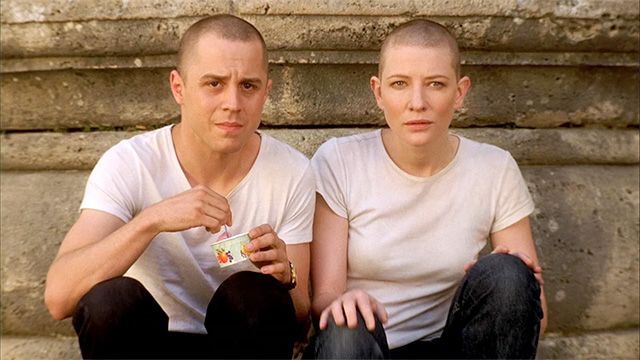
Sick of Myself? Sick of NewScreen? Nope.

One little pilly willy…

We started our new season in fine form tonight, with this captivating Norwegian film. I managed to get everything almost right, eventually. It’s funny how easy it is to forget all the little things that make NewScreen work.

Our short feature tonight was Maestro (which, of course, drove Tick crazy!) directed by Illogic. Great to see you all again.

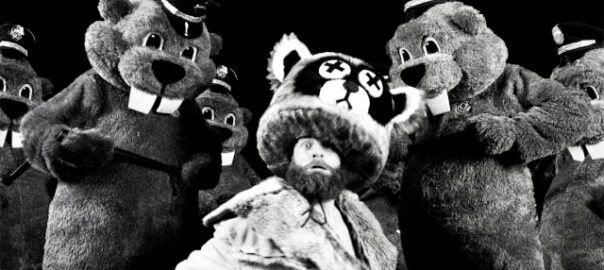
Hundreds of Beavers. OMFG.

Tonight’s feature was arguably the craziest thing I’ve ever seen. Our audience was enthralled, to say the least. What kind of imagination comes up with this kind of thing? Well, obviously that of Mike Cheslik. If you feel like being thoroughly entertained by 108 minutes of unrelenting visual thrills, gags, and slapstick, please watch Hundreds of Beavers.

Of course, our short feature tonight had to be Evil Beaver!

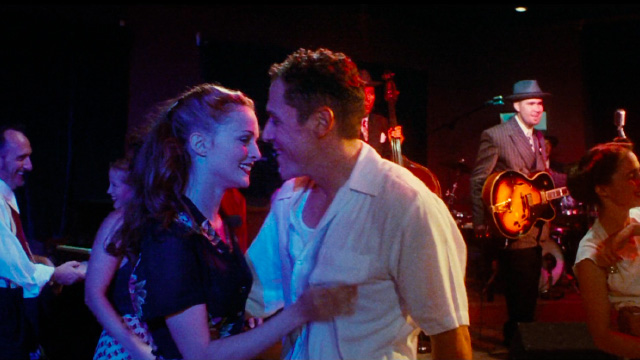
Swingers. Go Daddy-O!

28 years later, Swingers remains relevant, even though the answering-machine is pretty much a thing of the past. I mention the aforementioned device, because it plays a huge role in one of the cringiest and funny scenes in the movie. Poor Mike! (not to worry though… happy ending alert!)

Our crew was held enraptured, as happens most NewScreen nights. So happy I got this one off my to-show list!

Our short tonight was Tasty Fish, a music video that I directed in the early 90’s for The Other Two, after the split up of New Order. Is it ok that I featured my own work two weeks in a row???

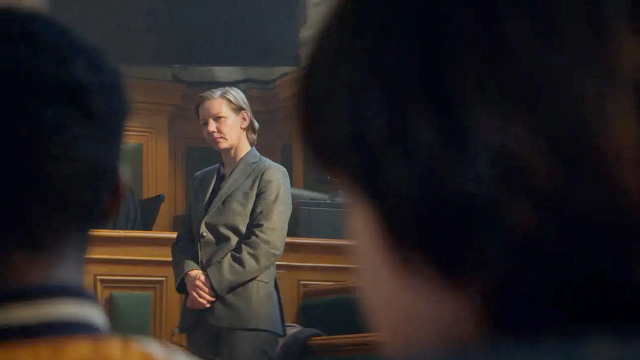
Anatomy of a Fall. Hail Hüller!

The weather tried it’s best to shut us down tonight, but we prevailed. Justine Triet’s Anatomy of a Fall was a transfixing view, and Sandra Hüller was at her finest. She managed to even be funny, in the face of everything happening to her. I got a bit excited, and considered re-visiting Toni Erdmann (her big breakout role). Probably not next week, but…

Past Lives. Finally.

Marry. Go round?

I watched this beautiful film with friends on a warm night last summer, on the big outdoor screen upstate, and kinda filed it away for “later”. In the meantime, a lot of glittering gems pushed their way into my queue. But with it’s Best Picture Oscar nomination, Celine Song’s Past Lives came back into sharp focus for me, and tonight was the perfect “later”.

It’s hard to say what makes this story so moving… but it manages to touch a few places that are difficult to access, in a very non-Hallmark way. Greta Lee was perfectly cast as Nora, although she did seem to have aged significantly more than her childhood sweetheart Hae Sung (Teo Yoo). In the end, though, it doesn’t really matter. The bond between them is totally palpable. Of course I cried.

Lovely to see new guests here tonight, along with our loyal regular crew.

Decision to Leave. To leave a us all a little confused?

Park Chan-wook’s Decision to Leave is certainly a beautiful, well crafted work, adored by critics, but somewhat hard to follow. A detective investigates a murder, the prime suspect of which is the victim’s beautiful Chinese wife, Song Seo-rae: a foreigner in Korea. She is quite “un-shocked” by the death of her husband, further cementing her prime suspect status.

Detective Jang Hae-joon, however, is seduced by her beauty and isn’t really able to concentrate on solving the crime. Jang also happens to be married, and his wife looks remarkably like Song. Further confusion. Anyway… I still love the movie, and in particular, the way “the affair” ends.

Thanks to my loyal guests for sharing a memorable evening with me, once again.

Head-On. Spot on.

Returning to NewScreen (well technically not, since it was first screened at MovieNight) some 15 years later, Head-On remains as thrilling and sexy as ever, and this week, served as a little German lesson for the Whitehouses. Happy to do my part.